

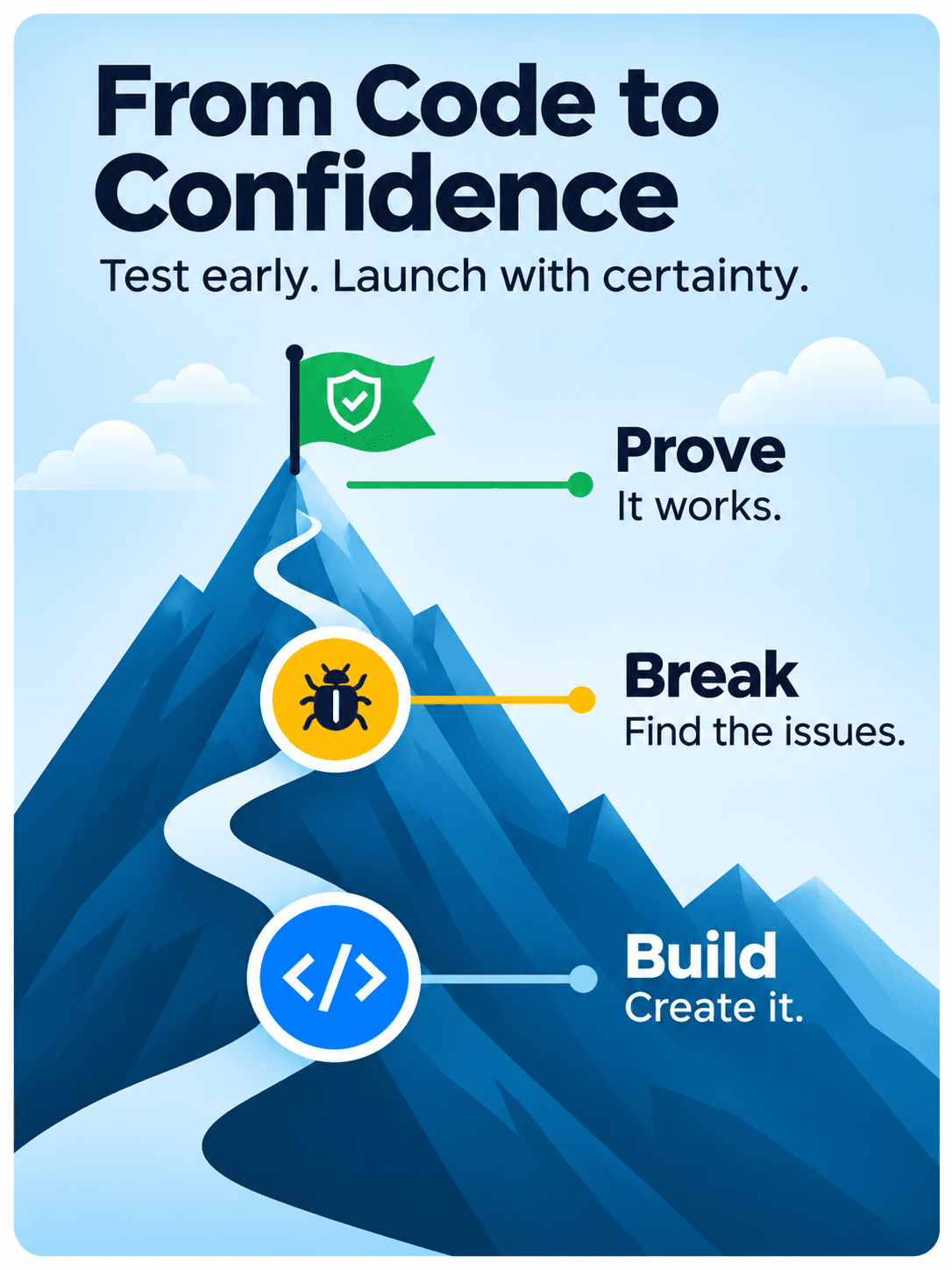
Software testing services are more important than ever in the age of AI. AI helps teams build software faster. But faster development does not always mean better software. There is a big difference between software that works once and software that works every time.
Small projects and simple websites may only need basic testing. Larger software systems need a more detailed testing plan. Testing helps make sure your software works for real people, not just developers.
Why Are Software Testing Services Important?
When developers build software, they often focus on the easiest path to success. This is called the happy path. It is the path users are expected to follow. But real users don't always follow that path.
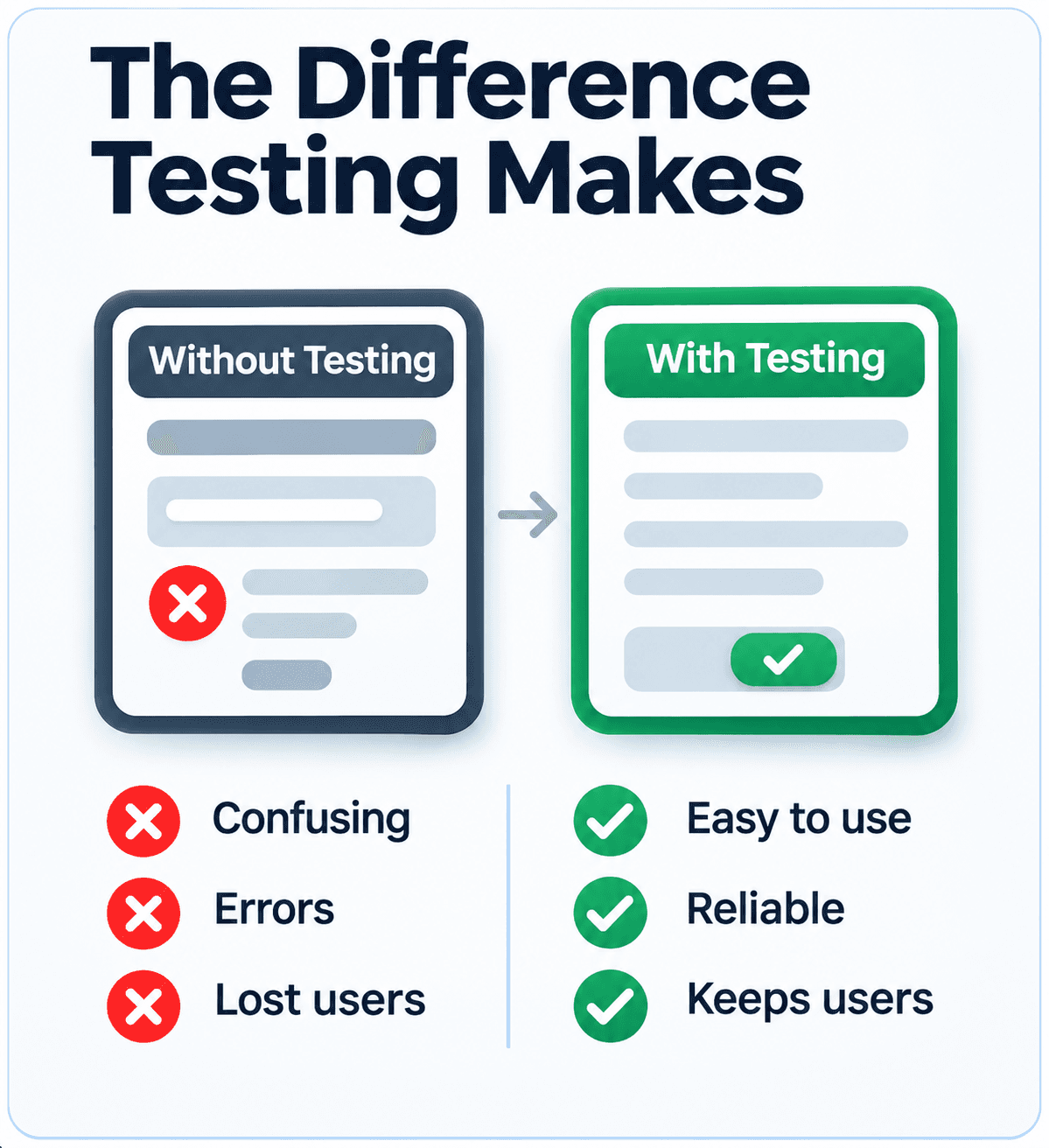
They click the wrong buttons. They enter unexpected information. They use features in ways no one planned for. When software fails, users get frustrated. Some stop using it altogether. This is called customer churn. Professional software testing services help find these problems before customers do.
The goal is simple: make sure users can complete their tasks, even when they take a different path.
5 Key Benefits of Software Testing
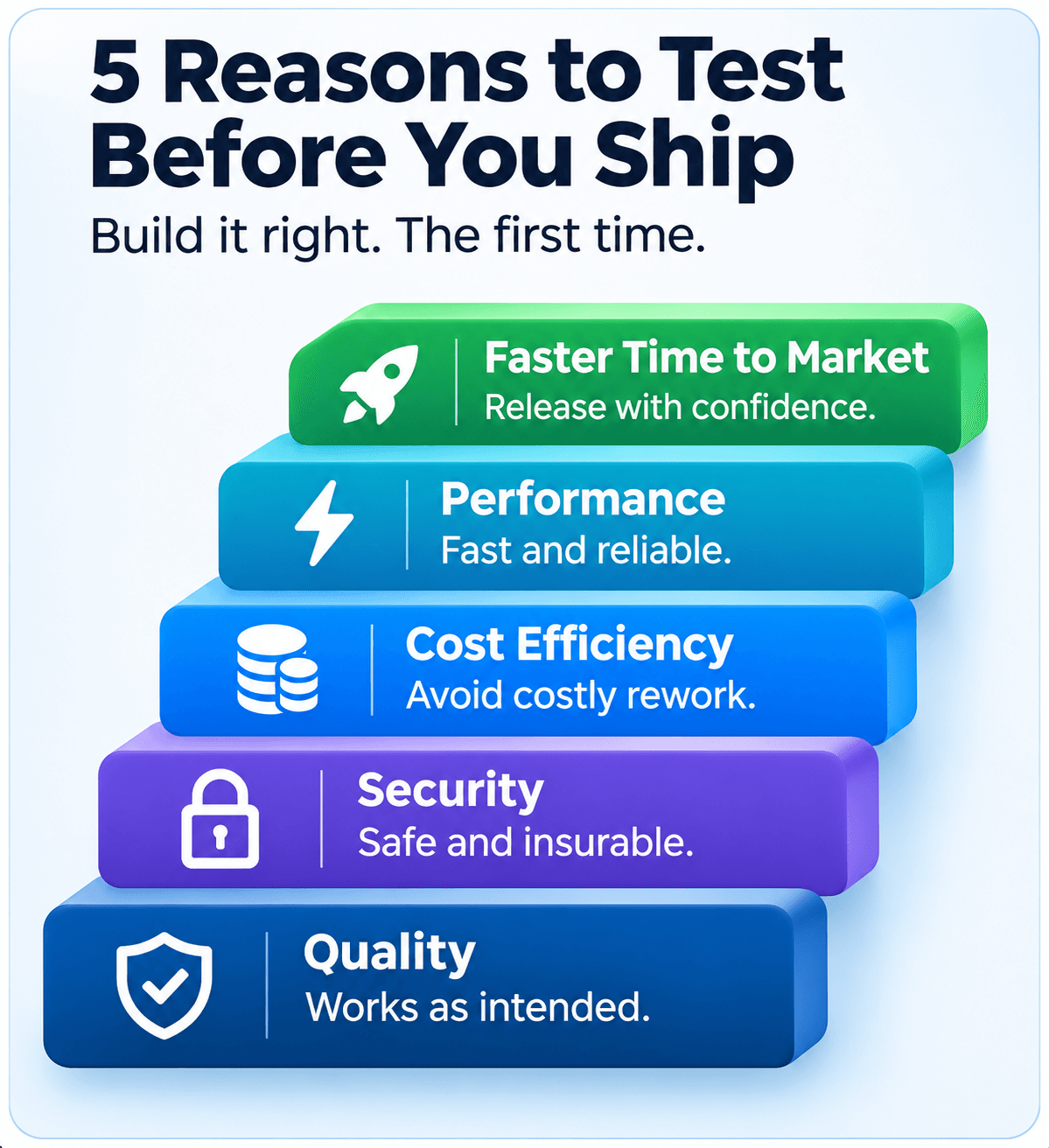
Good software needs to be safe, fast, easy to use, and able to grow with your business. A reliable software testing company helps businesses achieve these goals through planned testing, clear reporting, and early bug detection.
The five main benefits are:
- Better software quality
- Stronger security
- Lower development costs
- Better software performance
- Faster time to market
Let's look at each benefit.
Benefit 1: Better Software Quality
People want software that works and is easy to use. Without testing, software can have bugs, confusing menus, and features that don't work as expected. These problems make users unhappy. Testing helps teams find and fix these issues before release.
Usability Testing Services
Usability testing services show how real people use your software. We give users a task and watch how they complete it. We look for things like:
- Where users get confused
- Which buttons they struggle to find
- Where they make mistakes
- Which tasks take too long
- What stops them from finishing a task
People rarely use software exactly as developers expect. That is why testing with real people matters. AI can help with testing, but it cannot fully replace watching real users. The goal is to build software that people find easy to use, not just software that developers think is easy.
Software Quality Assurance Testing Services
Software quality assurance testing services help teams find bugs and check that software works as expected. Quality assurance (QA) also looks at how software is built, with the aim of preventing problems before they happen.
There is an old joke about a QA engineer who walks into a bar. The engineer orders:
- One beer
- Zero beers
- 99,999,999,999 beers
- A lizard
- Negative one beer
- A random string of letters
Everything works. Then a real customer walks in and asks where the bathroom is. The bar bursts into flames. The joke makes an important point. Developers can test many things and still miss what real users might do.
QA testers look for these gaps. They test normal actions, unusual inputs, errors, and unexpected user behaviour. The goal is to find problems before customers do. In other words, good QA testing helps stop your software's version of the bar bursting into flames.
Benefit 2: Stronger Software Security
If your software stores private data, security matters. Think about the locks on your house. Would you feel safe if you had never checked whether they worked? Software security works the same way. You need to test your security controls to know whether they work.
Security Testing Services
AI is changing how software is built. It is also changing how attackers find and use security flaws. Security testing services help find weak points before attackers can use them. They can help protect:
- Customer information
- Business data
- User accounts
- Payment systems
- Software services
Poor security can lead to data breaches, lost trust, and high recovery costs. In Australia, some data breaches must also be reported to the Office of the Australian Information Commissioner (OAIC). Regular security testing can help lower these risks.
It can also provide useful evidence when applying for cyber insurance. However, testing alone does not guarantee insurance cover.
The Role of a Software Testing Company in Security
A software testing company uses both automated tools and hands-on testing to find security risks. Automated tools can scan software for known weaknesses. Security testers then look for problems that tools may miss. Common tests include:
- Access control testing: Can users see data they should not see?
- Penetration testing: Can someone break into the system?
- Denial-of-service testing: How does the system respond to unusually heavy traffic or attacks?
- Data security testing: Is private information stored and shared safely?
A good testing company does more than give you a list of bugs. It should explain what was tested, what risks were found, and which problems need attention first. It should also show which security controls were checked and how the tests were carried out.
This helps your team make better security decisions and provides useful evidence for security reviews.
Benefit 3: Lower Software Development Costs
Software bugs cost time and money. When a bug reaches a customer, several people may need to help fix it. This can include:
- Developers
- Customer support teams
- Product managers
- QA testers
- Customers themselves
A single bug can interrupt the work of many people. Finding bugs before release is often much cheaper than fixing them later. Automated testing can help catch common problems. But automated tests only check what they were built to check.
If your team misses a possible problem, the test may miss it too. That is why a good testing plan uses both automated and manual testing.
Outsourced Software Testing Services
Sometimes an outside team can find problems that an internal team has missed. Internal developers know the software well. But that can make it harder to spot confusing features or unexpected issues. An outside testing team brings a fresh view.
Outsourced software testing services can help check:
- User experience
- Software design
- Security
- Performance
- Features and workflows
They also give businesses access to skilled testers without hiring a full-time team. You can bring in people with the right skills for your software. When the work is complete, you can reduce the team size.
This can be more cost-effective than building a permanent testing team, especially when your testing needs change.
How Software Testing Saves Money Over Time
Early in my software development career, I didn't see much value in testing. I had never released software to a paying customer. That changed when I understood what happens when a customer finds a serious bug.
A customer who cannot use your software may stop paying for it. Now you have two problems. You need to fix the bug, and you may have lost a customer. Testing helps reduce both risks.
It can lower support costs, reduce customer churn, and improve customer satisfaction.
Benefit 4: Better Software Performance
Speed matters. Slow software frustrates users. It makes simple tasks take longer and can cause people to leave. Amazon has often been used as an example of how speed affects sales. Even small delays can change how people use a website or application.
For business software, slow performance can interrupt daily work. For healthcare software, delays can sometimes create serious safety risks.
Software Performance Testing Services
Software performance testing services check how applications work under different levels of demand. For example, what happens when 10 people use your app? What about 1,000 people? Or 100,000? Tools such as Apache JMeter and Grafana k6 can simulate users and measure how the system responds.
These tests help find:
- Slow pages
- Long response times
- Server overload
- Memory problems
- Systems that fail under heavy traffic
Performance testing also helps teams understand how much demand their software can handle before it slows down or fails. The goal is to find these problems before they affect real users.
Measuring Software Performance Metrics
Testing speed is not just about checking how much CPU or memory your software uses. What matters most is the user's experience. Useful performance measures include:
- Response time: How long does the software take to respond?
- Load time: How long does a page or feature take to open?
- Error rate: How often does something fail?
- Throughput: How much work can the system handle?
- Resource use: How much CPU, memory, or network capacity does it need?
Your team also needs good monitoring tools. This helps you see where slowdowns happen and what causes them. The best performance measures focus on what users need to do, not just numbers that look good in a report.
Benefit 5: Faster Time to Market
Testing may seem like extra work. But it can help your team release software faster. Without testing, developers often spend time fixing unexpected bugs. These bugs interrupt planned work. Product managers need to change priorities. Developers stop building new features. Support teams deal with unhappy users.
A good testing process helps prevent this. It turns many surprise problems into planned tasks. This gives developers more time to build useful features.
Streamlined Software Testing Processes
Testing works best when it is part of your development process. It should not be something you do only before release. A strong testing process has several layers:
- Unit testing: Developers check small parts of the code.
- Automated QA testing: Tests check common features and expected results.
- End-to-end testing: Tests check complete user journeys.
- Platform testing: Tests check different devices, browsers, and systems.
- Manual testing: Real testers look for problems that automated tests may miss.
Many of these tests can run automatically. This saves time and helps teams find problems earlier. But some manual testing will always be useful. Automated tests also need regular updates as the software changes. The best approach is to automate repeatable checks and use human testers for tasks that need judgement.
Agile Methodologies in Software Testing
Agile development is about building and improving software in small steps. Instead of building everything at once, teams complete small pieces of work. They test each piece before moving forward. Eric Ries explains a similar idea in his book The Lean Startup.
Imagine you need to wrap 100 gifts. You could wrap all 100 gifts first, then add all the bows, then add all the cards. Or you could finish each gift one at a time. The second approach may seem slower.
But what if you discover that you have been wrapping every gift the wrong way? If you work in small batches, you find the mistake sooner. Software testing works in a similar way. Testing small changes helps teams catch problems before they spread.
It may feel slower at first. But finding problems early often helps you move faster overall.
Frequently Asked Questions About Software Testing Services
What are software testing services?
Software testing services check whether an application works correctly, stays secure, and performs well. They use manual and automated tests to find bugs before users do. Testing helps businesses release reliable software, reduce errors, and improve customer satisfaction.
What are the main types of software testing?
The main types include functional testing, usability testing, security testing, performance testing, and regression testing. Each checks a different part of your software, from how features work to how the system handles heavy traffic, security threats, and new updates.
What is the difference between QA and software testing?
Quality assurance (QA) focuses on preventing problems throughout software development. Software testing checks the application to find bugs and confirm it works as expected. Testing is one part of QA. Together, they help teams build better software and reduce costly errors.
How much do software testing services cost?
Software testing costs depend on the application's size, complexity, and testing needs. Manual testing, automated testing, security assessments, and performance testing have different costs. A software testing company can review your requirements and recommend a testing plan that fits your budget.
Great Software Doesn't Happen by Accident
Your software might work perfectly during development. But what happens when 1,000 users log in at once? What if someone enters the wrong data, a server slows down, or a security flaw goes unnoticed? These are the problems that turn good software into unhappy customers, lost revenue, and late-night bug fixes.
The best time to find these problems is before your customers do. But knowing you need software testing is one thing. Knowing what to test, when to test it, and how to build a process that works is another.
That's where a clear testing plan makes the difference.
Build a Better Software Testing Process With Biz365
You don't need an ASX 100 budget to start testing software like a large company. At Biz365, we've put together 10 Tips for an ASX 100-Level Software Testing Pipeline to help you take the next step.
Learn how to find problems earlier, reduce costly bugs, and build a testing process that helps your team release better software, faster. Download our 10 Tips for an ASX 100-Level Software Testing Pipeline and start building software your customers can rely on.