Custom software costs more than writing code. A useful budget must cover the problem, the design, the build, testing, security and the support needed after launch.
For Australian organisations, the budget may also need to cover integrations, privacy, data migration, compliance and the work your own team must do during delivery.
There is no single average cost of custom software development that can predict every project. The useful question is not only “How much does software cost?” It is “What will this system need to do, and what will it take to make it reliable?”
What is the average cost of custom software development?
Published Australian guides show how wide the range can be:
| Project type | Indicative build budget, AUD | What changes the price |
|---|---|---|
| Small application or MVP | $30,000–$80,000 | Core workflow, users and essential features |
| Mid-complexity business system | $80,000–$250,000 | Roles, reporting, integrations and data |
| Enterprise platform | $250,000–$600,000+ | Cross-business workflows, security and scale |
These are vendor benchmarks, not independently measured market averages. The figures come from published industry guidance, including Hatchet’s custom software cost guide. Other studios publish lower ranges for smaller automations and internal tools. That difference is a reminder to compare like with like.
Before comparing a number, check:
- whether GST is included
- whether discovery and design are included
- how testing and security are handled
- which integrations are part of the estimate
- who owns the code and infrastructure
- what support costs after launch
Biz365’s own new-build range is commonly $40,000–$80,000. Smaller automations may cost less. The useful first step is to define the first version and the result it must deliver.
What sits behind the price?
A screen is only one part of a system. Before requesting software development quotes, describe the work behind the screen.
Workflow complexity
Approvals, exceptions, permissions and business rules often take more work than the normal user journey. Ask what happens when information is missing, a person rejects a request or two systems disagree.
Integrations
A system may need to connect to Microsoft 365, accounting software, customer records, payment services or another internal platform. Ask who is responsible when an external system changes or an update fails.
Data migration
Moving old records can involve extraction, cleaning, duplicate checking, testing and reconciliation. If the data is not ready, the project may need a separate preparation stage.
Operating expectations
The estimate should account for users, availability, accessibility, backups, monitoring and recovery. A small internal tool and a system used by thousands of people have different operating needs.
Delivery responsibilities
A serious estimate should say who is responsible for discovery, design, project management, development, testing, deployment, documentation and training. It should also say what decisions and information your own team must provide.
Instead of asking for “a customer portal”, describe who signs in, what each role can see, which system supplies the data and what should happen when an update fails. Clearer requirements produce more useful quotes.
How does Australian compliance affect the budget?
Compliance is not a universal percentage added to a project. It affects the controls, documentation, testing and operating processes required for that particular system.
For example:
- Financial services organisations may need to consider APRA CPS 234, including controls and testing for information assets managed by third parties.
- Organisations providing health services may hold health information covered by the Privacy Act, even when they are small businesses. OAIC guidance can help clarify the obligations.
- Government-related systems may need to consider whether an IRAP assessment is required and what its scope would be.
- The Australian Privacy Principles may require clear rules for protecting, retaining, destroying or de-identifying personal information.
The right question is not “What is the compliance surcharge?” It is “Which obligations apply, and what work must the system and its operators do to meet them?”
Security should be considered through architecture, development, testing, deployment and maintenance. Australian secure-by-design guidance is useful when asking a supplier to explain what security work is included.
Match the contract to the uncertainty
The commercial model should match how certain the requirements are.
Fixed price
A fixed price can work when the requirements and acceptance tests are stable. Ask how changes will be handled before signing.
Time and materials
Time and materials can work when discovery and user feedback will shape the solution. Ask for regular forecasts, spending checkpoints and a clear view of remaining uncertainty.
Dedicated team
A dedicated team needs clear role allocation, reserved capacity, minimum commitments and a decision about who sets priorities.
Product delivery
For a product-delivery engagement, define what the supplier owns, what remains with your organisation and how success will be accepted.
The label matters less than the detail. Ask suppliers to separate discovery, implementation, third-party charges and post-launch support.
How should you compare software development quotes?
Send each shortlisted supplier the same brief. Then compare the quotes against the same requirements, acceptance criteria and operating assumptions.
Ask each supplier:
- Are design, architecture, code, deployment and documentation included?
- What evidence proves that the features work?
- How will performance and security be tested?
- Who provides data access, content, credentials and decisions?
- Who owns the source code, repository and infrastructure?
- How will changes be approved and priced?
- Which support is included, and what is treated as an enhancement?
Be careful with vague exclusions, undefined testing and claims of “full compliance” without named requirements. If a supplier promises AI-driven savings, ask which activities change and how those savings will be measured. Faster code generation is not proof of a reliable system.
Budget for the years after launch
The first build is only part of the investment. Request separate estimates for:
- hosting and infrastructure
- monitoring and backups
- third-party subscriptions
- support and incident response
- dependency updates
- security reviews
- user training
- future enhancements
- eventual handover or retirement
Some vendors use an annual maintenance rule of roughly 15%–20% of the original build cost as a planning guide. That is not a universal requirement. Ask for a support proposal based on the system, users, service level and risks involved.
Keep contingency separate from feature work. Each allowance should relate to a named uncertainty, such as an untested integration or incomplete migration data. Revisit it as discovery resolves the risk.
Build the investment case before expanding scope
Start with a measurable outcome:
- fewer manual processing hours
- faster approvals
- less duplicate data entry
- fewer support calls
- better evidence for funding or reporting
Set a baseline before the build and nominate someone to check the result after launch. Do not count theoretical time savings as cash savings unless they genuinely reduce expenditure or create usable capacity.
For illustration, suppose a project costs AUD $180,000, produces $100,000 in measurable annual benefits and costs $30,000 a year to operate. The net annual benefit is $70,000, giving a simple payback period of about 2.6 years. These are hypothetical figures, not a market benchmark.
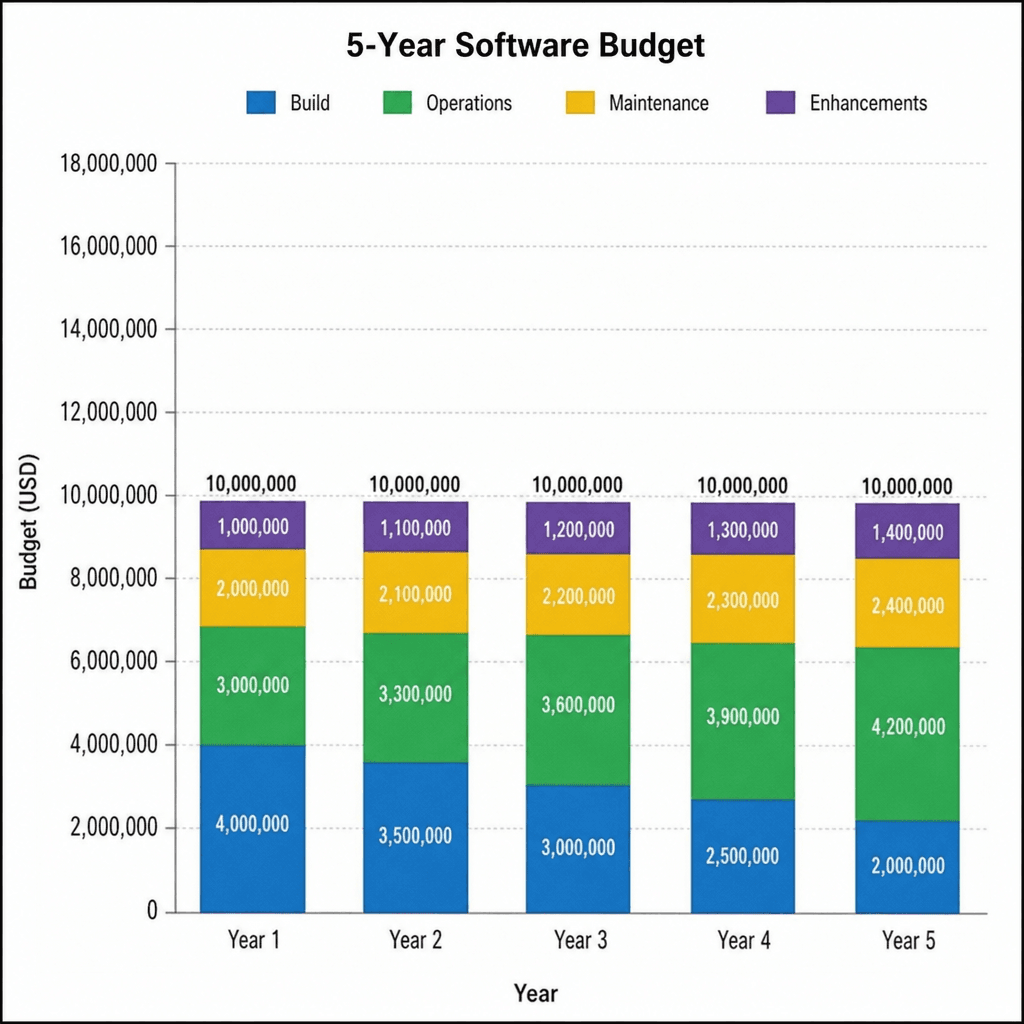
Build a five-year total-cost-of-ownership view. Include implementation, operations, planned improvements and exit. Then test what happens if adoption is slower than expected. If the investment case does not work, reduce the first scope or compare an off-the-shelf option before committing.
A defensible budget starts with clarity
Price ranges are useful for orientation, not promises. Define the outcome, resolve the major uncertainties and compare suppliers against the same requirements.
A useful proposal makes the full commitment visible:
- what will be delivered
- how it will be accepted
- what remains excluded
- who owns the code and data
- what it will cost to operate
- what support is available after launch
If standard software solves the problem, it may be the better choice. If the gap is real, custom software development in Perth can give your organisation a system built around the work it actually needs to do.
Book a practical first call to discuss the problem, the likely options and the next sensible step.